

Note
Go to the end to download the full example code.
Detect CROCO-GIGATL1 eddies at 1000m#
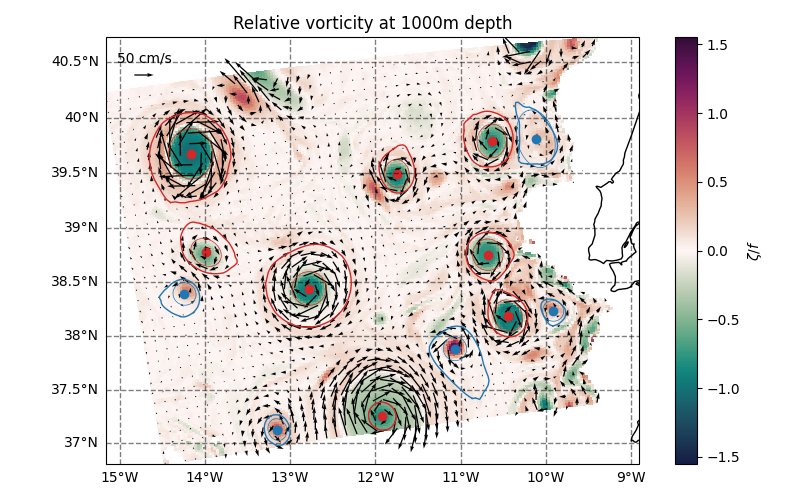
In this example, eddies are detected from CROCO model currents interpolated to 1000 m and collocated at RHO points.
Initialisations#
Import needed stuff.
import time

import cmocean as cm
import matplotlib.pyplot as plt
import xarray as xr

from shoot.dyn import get_relvort
from shoot.eddies.eddies2d import Eddies2D
from shoot.meta import set_meta_specs
from shoot.plot import create_map, pcarr
from shoot.samples import get_sample_file

xr.set_options(display_style="text")
<xarray.core.options.set_options object at 0x7026ac9b6dd0>
Read data
Detect eddies#
Parameters#
Window size in km to compute the LNAM and find eddy centers
window_center = 50
Window size in km to fit SSH and make other diagnostics like contours
window_fit = 120
Minimal radius of an eddy to retain it
min_radius = 10
Ellipse error preconised 1% for deep field, 5% to 10% to surface field
ellipse_error = 0.02
Detection#
start = time.time()
eddies = Eddies2D.detect_eddies(
    ds.u,
    ds.v,
    window_center,
    window_fit=window_fit,
    min_radius=min_radius,
    paral=False,
    ellipse_error=ellipse_error,
)
end = time.time()
print(f"Number of detected eddies {len(eddies.eddies)} in {end - start:.1f} s")
Number of detected eddies 13 in 38.6 s
Plots#
We plot eddies with the relative vorticity as background.
fig, ax = create_map(ds.lon_rho, ds.lat_rho, figsize=(8, 5))
vort = get_relvort(ds.u, ds.v) / 1e-4
cb = vort.plot(
    x="lon_rho",
    y="lat_rho",
    cmap=cm.cm.curl,
    ax=ax,
    add_colorbar=False,
    transform=pcarr,
)
plt.colorbar(cb, label=r"$\zeta/f$")
nj = 4
qv = plt.quiver(
    ds.lon_rho[::nj, ::nj].values,
    ds.lat_rho[::nj, ::nj].values,
    ds.u[::nj, ::nj].values,
    ds.v[::nj, ::nj].values,
    transform=pcarr,
)
plt.quiverkey(qv, 0.18, 0.85, 0.5, "50 cm/s", coordinates='figure')

for eddy in eddies.eddies:
    eddy.plot(transform=pcarr, lw=1, boundary=True)
plt.title("Relative vorticity at 1000m depth")
plt.tight_layout()
Total running time of the script: (0 minutes 39.563 seconds)